Automatic sliding and swing gates can both provide convenient controlled entry, but they use the site in very different ways. Choosing between them should begin with measurements, structure, traffic, and movement hazards—not with the motor or remote control. A gate that suits a villa may be unsuitable for an apartment driveway or industrial entrance, even when the opening width looks similar.
How the two gate types move
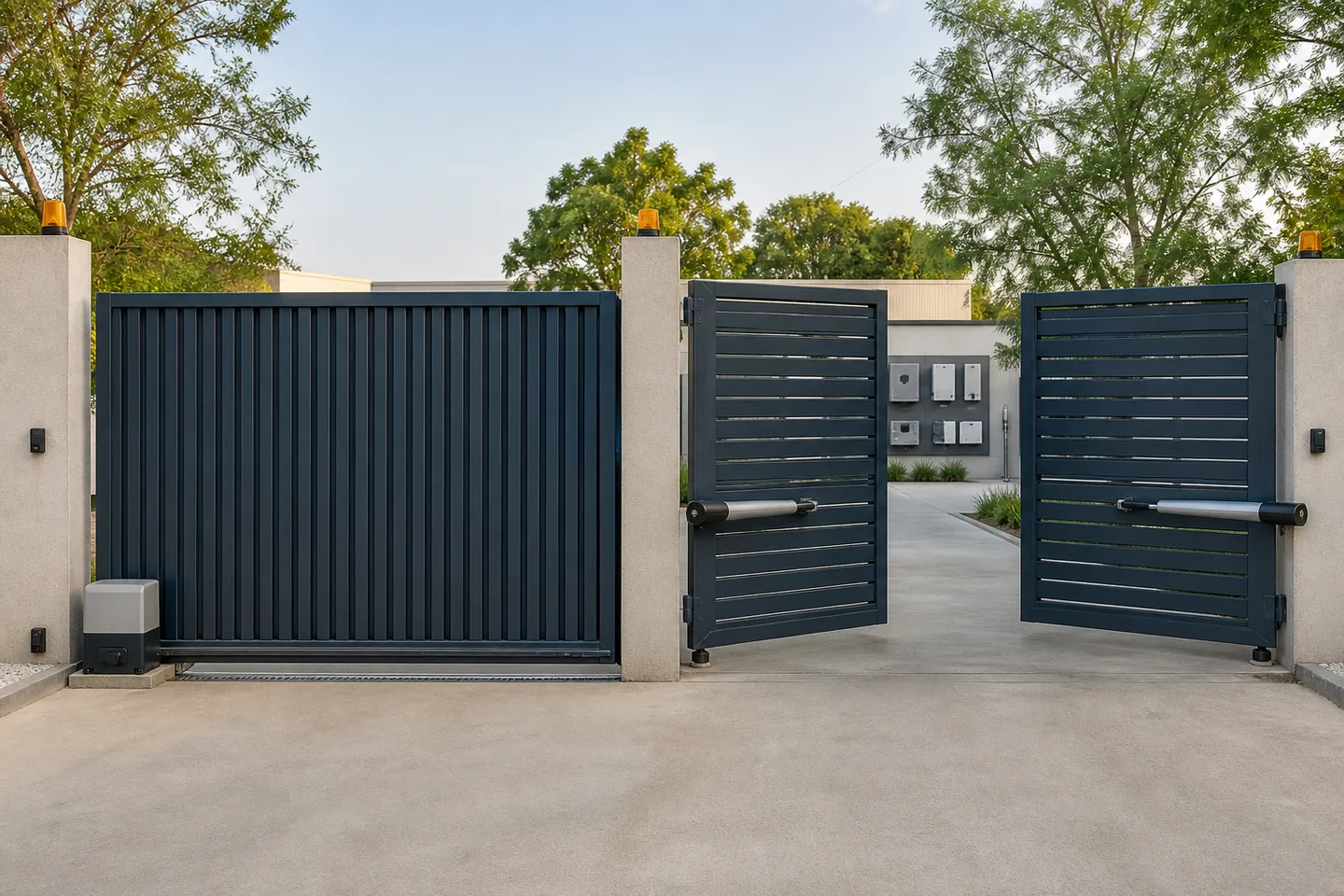
A sliding gate travels sideways along the boundary. A tracked system runs on a ground rail, while a cantilever arrangement is supported above the driveway by engineered rollers and structure. Sliding movement can work well where the driveway immediately inside the entrance must remain clear, provided there is enough usable runback space beside the opening.
A swing gate pivots on hinges and opens inward or outward through an arc. It can create a traditional, balanced appearance and may suit properties with strong gate posts and sufficient clear depth. The entire sweep area must remain protected from parked vehicles, landscaping, pedestrians, slopes, and other obstructions.
Measure more than the clear opening
For a sliding gate, record the opening width, available side space, gate length, ground level, drainage, boundary alignment, and room for the motor and end stops. The runback area must remain clear throughout the full travel. A cantilever gate generally needs additional tail length and suitable support foundations.
For a swing gate, measure the leaf width, opening angle, driveway depth, slope, post condition, hinge geometry, and clearance from walls or property lines. A steep rising driveway can conflict with an inward-opening leaf. Outward opening may affect a pavement or road and must not be assumed to be acceptable.
Consider traffic and operating rhythm
Vehicle type and frequency influence the practical choice. A residence with a limited number of daily movements has different demands from a factory gate serving delivery vehicles. Record peak traffic, vehicle length, turning path, queuing space, and how visitors request access. The gate should not begin closing while a long vehicle is still occupying the controlled area.
Opening time is influenced by leaf size, travel distance, motor selection, settings, and site conditions. It should be assessed as part of the complete project rather than promised from a product name alone.
Review gate structure and environment
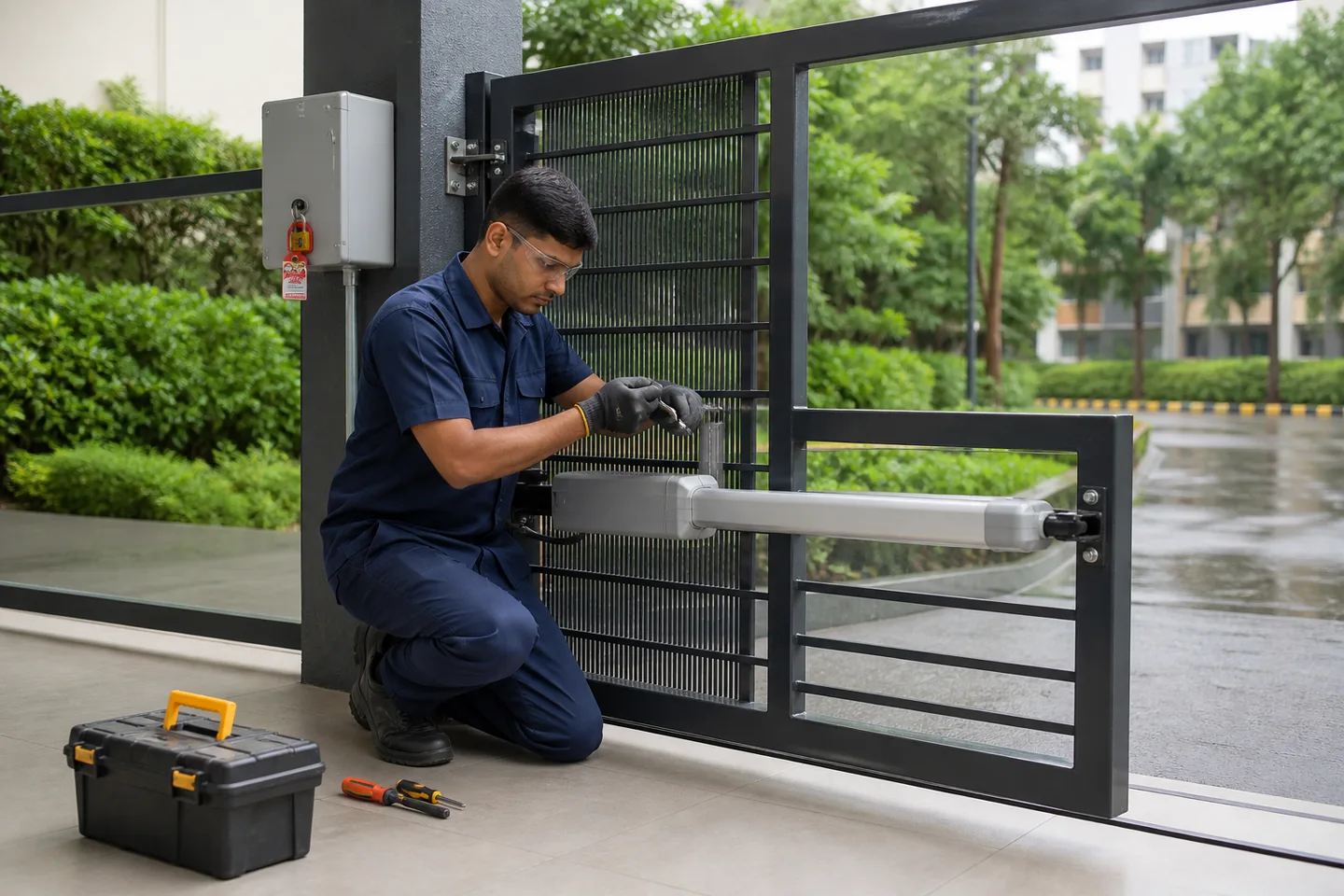
Automation cannot correct a gate that is badly fabricated, difficult to move, out of square, or supported by weak posts and foundations. Before selecting the operator, the gate leaf, hinges, wheels, rail, frame, posts, stops, and mounting points should be inspected. Wind loading can be significant for solid gate leaves, particularly on wide or exposed entrances.
Dust, water, leaves, loose stones, and vehicle debris may affect ground tracks and exposed mechanisms. Drainage should prevent water from collecting around motors, control enclosures, foundations, and cable routes. The equipment and installation details should suit the exposure of the actual location.
Plan safety around the movement
Both gate types create moving zones that must be considered during design. Depending on the system and risk assessment, the project may use photocells, presence detection, safety edges, warning indicators, physical guarding, controlled operating speeds, or other protective measures. No single accessory replaces correct layout and commissioning.
Sliding gates require attention to the travel line, closing edge, fixed structures, runback area, and locations where a person could be trapped. Swing gates require attention to the opening arc, hinge area, leading edge, and spaces between the leaf and adjacent objects. Children, pets, pedestrians, motorcycles, and delivery staff should be considered—not only cars.
Choose access control for the site
Remote controls, key switches, intercoms, RFID devices, loop detectors, mobile access, reception release, and other systems can be integrated where compatible. The right method depends on who uses the entrance, how visitors are handled, and what happens outside normal hours. Vehicle detection should be designed carefully so that an access request and a safety presence signal are not confused.
Make the decision with a site survey
Sliding gates are often strong candidates where lateral space is available and driveway depth must remain clear. Swing gates can suit entrances with adequate opening arcs and sound posts. These are starting points, not universal rules. The Elite Automatic Doors can measure the site, review traffic and access needs, and recommend a configuration based on the property rather than a generic comparison.
Every opening, traffic pattern, and control requirement is different. Share your site details so our team can assess the practical options.
Discuss your requirement →