
Helpful Answers
Frequently Asked Questions
Clear, site-aware answers about automatic entrance products, installation, maintenance, safety planning, and support.
Products
Which automatic entrance products do you provide?
The Elite Automatic Doors works with automatic sliding glass doors, sliding and swing gates, rolling shutters, parking boom barriers, flap barriers and turnstiles, automatic rooftop systems, and spider-fitting glass systems. Availability and suitability are confirmed after reviewing the site and requirement.
How does an automatic sliding glass door work?
An activation sensor sends a signal to the controller, which directs the operator to move the glass leaves along their track. Presence or safety sensors monitor relevant areas so the controller can respond according to the commissioned settings.
Should I choose an automatic sliding gate or swing gate?
A sliding gate needs clear lateral runback space, while a swing gate needs a protected opening arc and suitable gate posts. The decision also depends on gate weight, driveway slope, traffic, drainage, wind exposure, and the available structure.
Where are automatic rolling shutters commonly used?
They are commonly considered for shops, storerooms, service entrances, factories, and warehouses. The curtain, guides, motor, controls, and protective features should be selected for the opening size, usage, environment, and intended purpose.
What is the difference between a boom barrier and a turnstile?
A boom barrier manages vehicle entry using a moving arm. A turnstile or flap barrier manages pedestrian movement through a controlled lane. Either system may connect with compatible RFID, ticketing, visitor, or access-control equipment.
What is a spider-fitting glass system?
Spider fittings use point-fixed stainless-steel hardware to support frameless glass panels. They are used for architectural facades, entrances, and partitions where transparency and a minimal frame appearance are desired. Structural and glass specifications must be project-specific.
Installation & Maintenance
Why is a site survey required before installation?
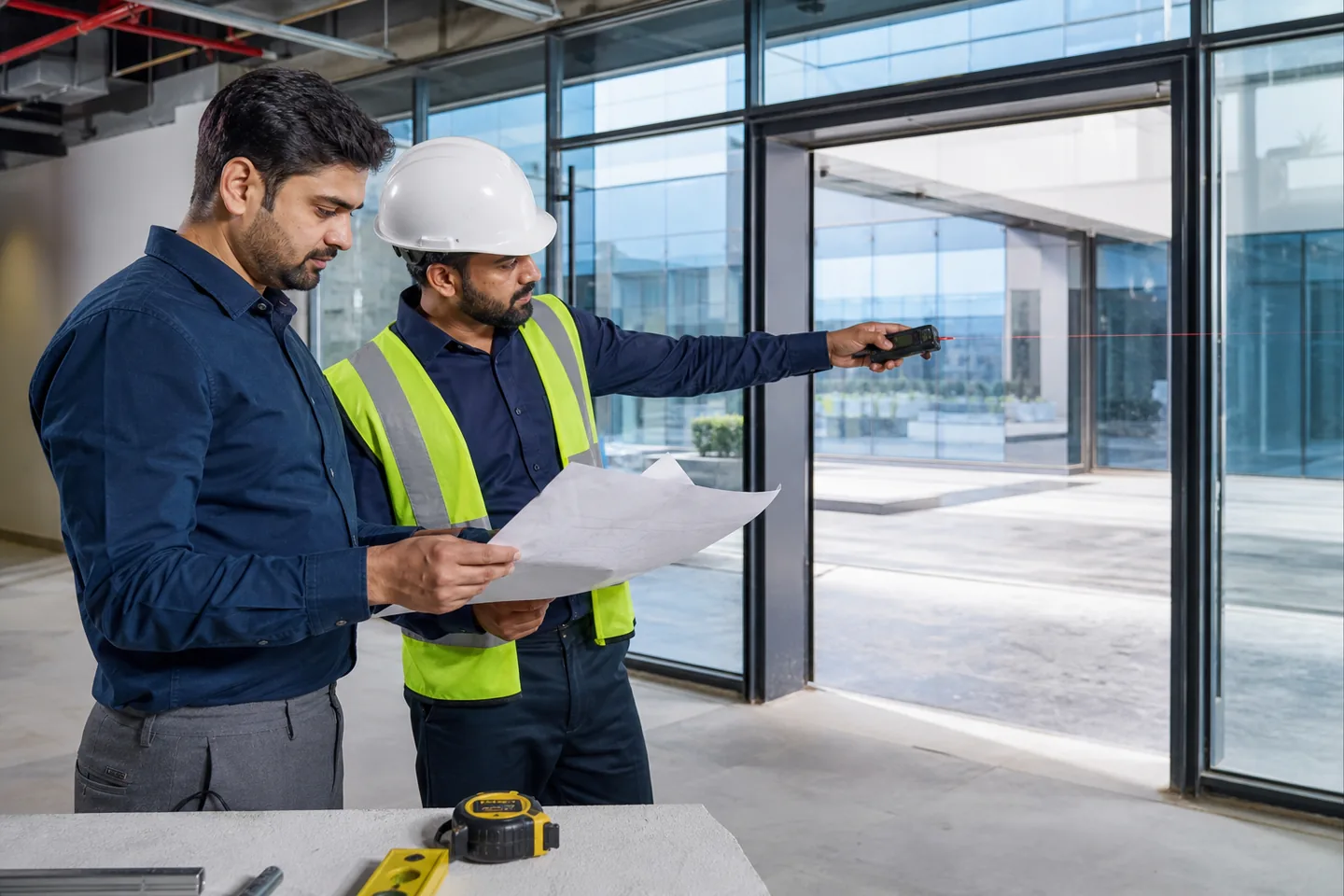
The survey records dimensions, structure, available movement space, traffic, floor level, drainage, electrical supply, access control, and service access. These details help determine whether a proposed system is practical for that entrance.
Can an existing manual entrance be converted to automatic operation?
Many entrances can be retrofitted, but the existing door, gate, frame, glass, hinges, rail, structure, and electrical arrangements must first be inspected. Some sites may require repairs or structural changes before automation.
How long does installation take?
Duration depends on the product, opening size, site readiness, civil or structural work, glazing, electrical work, access-control integration, and testing. A realistic schedule can be provided after the scope and site conditions are confirmed.
How often should an automatic door be serviced?
The interval should reflect traffic, environment, equipment condition, manufacturer guidance, and the building's operational needs. High-traffic, dusty, exposed, or industrial entrances may need different attention from sheltered, lightly used doors.
What signs indicate that an automatic door may need repair?
Common warning signs include unusual noise, hesitation, uneven movement, repeated reopening, unreliable activation, misalignment, impact damage, or a change in the normal closing position. Stop using a visibly unsafe entrance and request an assessment.
What can be included in an AMC or maintenance plan?
A plan may include scheduled inspection, cleaning of approved components, adjustment, functional testing, service records, and recommendations. Visit frequency, equipment covered, parts, exclusions, and fault-support arrangements should be clearly stated in the selected contract.
Project & Support
Which types of properties do you work with?
Projects may include hospitals, hotels, offices, shopping malls, showrooms, IT parks, apartments, villas, factories, and warehouses. Each application is assessed for traffic, access, environment, appearance, and operating requirements.
Can an automatic entrance connect with access control?
Compatible systems may integrate with card readers, RFID, intercoms, reception release, remote controls, loop detectors, ticketing, or other approved inputs. Compatibility and the required operating sequence must be confirmed during planning.
What safety features can be considered?
Depending on the product and site assessment, a system may use presence sensors, photocells, safety edges, obstruction response, warning indicators, guarded movement areas, or controlled speeds. Correct layout, commissioning, and user procedures remain essential.
What happens during a power failure?
Behaviour depends on the operator, gate or door configuration, control settings, battery or manual-release provisions, and the building's emergency plan. The intended response should be defined for the specific project and demonstrated during handover.
What information should I share for a quotation?
Share the site location, product or problem, approximate opening dimensions, photographs, property type, expected traffic, available power, preferred access method, and any relevant architectural or operational requirements. A site visit may still be needed.
Can you inspect or repair an existing system installed by another provider?
An existing system can be inspected to identify its make, condition, fault, available documentation, and component compatibility. Repair or replacement options depend on inspection findings and the availability of suitable parts.
Still deciding?
Get an answer shaped around your entrance.
Send the site location, product, approximate size, and a photo. Our team will help identify the next practical step.